Tuesday, January 3, 2023

The 1920s Champlain Bridge construction in photos

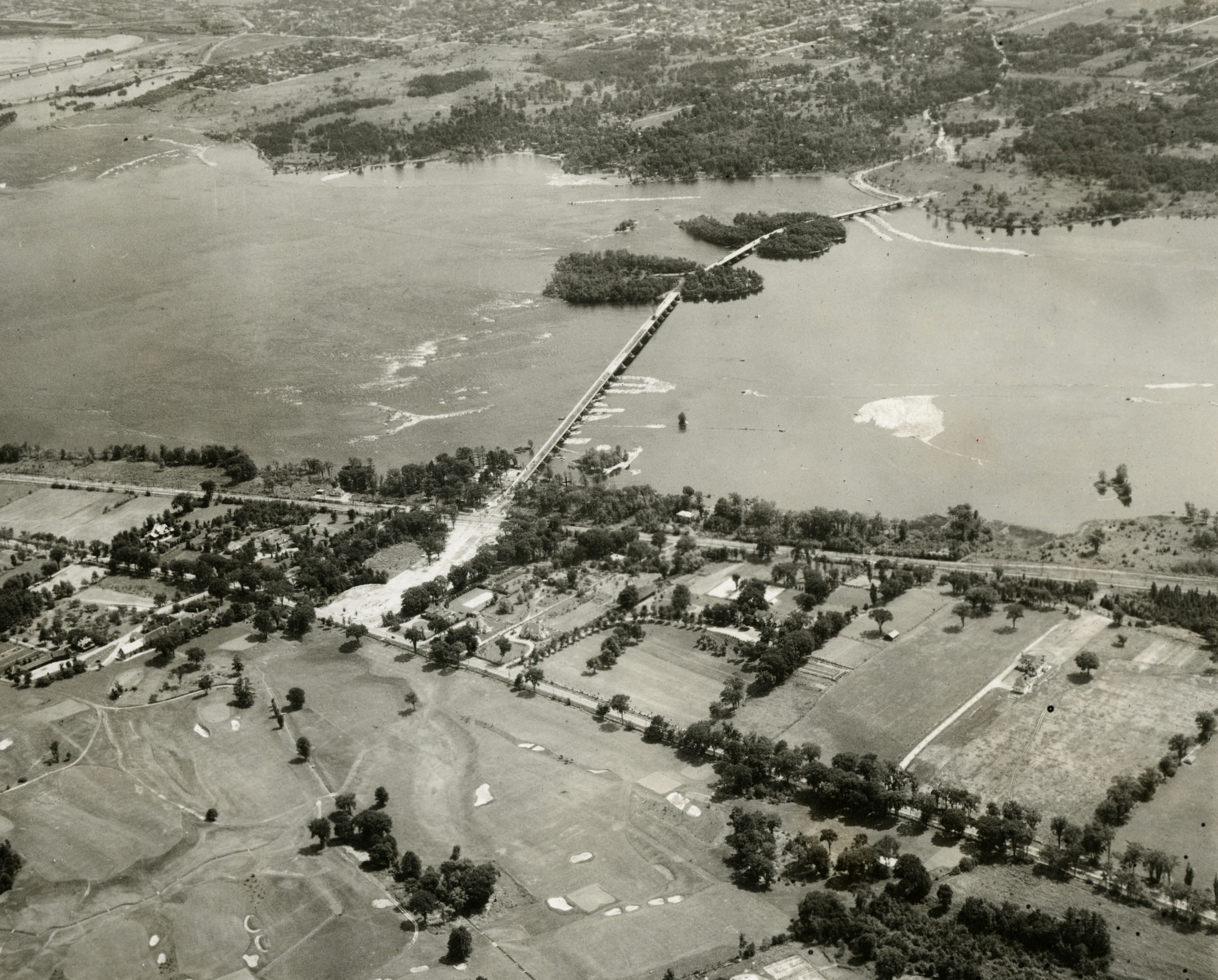
One of the most significant developments in the history of the west end occurred throughout the 1920s with the construction of Island Park Drive and the Champlain Bridge by the Ottawa Improvement Commission (now known as the NCC). 

As you can imagine, this was not an easy project to undertake, was hugely political, came at a great expense, and was fraught with many delays. Ultimately, the arrival of the automobile, the push for the "beautification" of Ottawa, and the optimism of the roaring twenties led to this incredible project which transformed the west end. 

I recently discovered a series of incredible, newly-shared photos on the Library and Archives Canada website (which is a rarity to find new content of any kind) showing the Champlain Bridge under construction. But not just aerial photos or boring bridge photos, but actually showing the men and machinery at work. It's an amazing glimpse into early 20th century engineering works, and helps bring to life the difficulties of building a bridge of that magnitude through the middle of the Ottawa River. I'm excited to share these photos today. 

I've also mixed in other photos I've found over the years showing the Bridge in various stages of completion. It took a long time for Island Park Drive and the Bridge to be built, all in small phases. I've done my best to create a bit of a timeline as well, to chronicle the development. In all honesty, a book could be written about the challenges that came about at each phase. No decisions were easy (where the driveway was to be located? Through which farms and properties would it go? To which islands would it go? Would it link to Quebec? Who would pay for it?). And on and on it went. 

* * *

Here is a timeline on the history of the Bridge, along with applicable photos over time:

July 1896: Robert H. Cowley acquires all of the land north of the CP Railway tracks (now Scott Street/Transitway) between Patricia and Carleton Avenue, right to the water (Nepean Township Lot 33, Concession A). 

March 1899: Cowley hires John Bower Lewis, Ontario Land Surveyor, to take a survey of the three islands in the Ottawa River.

April 1900: Cowley purchases the adjoining land to the west (the east half of Nepean Township lot 32), expanding his holdings to approximately present day Remic Avenue.  

September 1902: Cowley wrote to the Ontario Commissioner of Crown Lands to confirm his prioritized claim to the three islands off the shore of his lot 32 property. He also wrote to the Ottawa Improvement Commission (OIC) offering to waive his claim, and encouraging the OIC to acquire the islands, and build a connecting driveway through his (Cowley's) land. Word had obviously begun to spread in Ottawa about the OIC's interest in extending their Driveway (which at the time ended at the Experimental Farm) to the northwest. This was obviously a savvy move by Cowley, as the OIC driveway running through his property would drastically increase its value.

August 1903: Cowley lays out the subdivision plan for the Champlain Park neighbourhood (originally known as Riverside Park). The subdivision likely would have occurred soon anyways, but was likely fast-tracked to further appeal to the OIC as a popular summer resort location in the west end (which it soon became). You can read more about Cowley and the early days of Champlain Park in an article I wrote last year at https://kitchissippi.com/2021/10/12/robert-h-cowleys-vision-and-the-birth-of-champlain-park/ 

Early 1907: The OIC acquires the three islands from the government of Ontario.

July 1907: Commissioners of the Ottawa Improvement Commission visited the area and held a small ceremony to announce that the islands had been given names (after members of the Commission themselves!) and that these islands would be the terminus of the proposed new western driveway.

 Ottawa Journal - July 6, 1907

1907-1920: Nothing happens. No official project is announced, no work is done. Cowley, believing that the driveway is coming soon, begins using the coming driveway in promotion for Riverside Park lots, but anyone buying a lot in anticipation would require a lot of patience. Eventually the OIC discovers that the area flooded heavily each year, and that portions of the planned roadway would spend the spring months under as much as 15 feet of water. By 1911 the driveway plan was considered a "mistake" and cancelled. Once WWI hits, any hope of revisiting the concept stalls completely. Some of Cowley's lot buyers/investors were not happy.

December 24, 1920: On Christmas Eve, it is front page news in Ottawa that as part of their spending plan for 1921, the OIC will build the driveway extension to Riverside Park. Though since all the land required for the project had not been acquired yet, they could not announce the official route yet. 

Aerial photo from 1920 showing the three islands
and a bit of Champlain Park at bottom left. You can
also see the accumulation of stray logs along the shore.


July 11, 1921: Work finally begins on construction of the West End Driveway! Phase one includes just the area from Richmond Road to the water's edge (Cowley's property), with some work to occur on Bate Island. 


1922: The stretch to the River from Richmond Road was completed sometime in 1922. These photos below are from LAC and are undated, but are likely from 1922 or 1923. You can see the Driveway suddenly and quietly ends at the River, where you could drive your Model T right up to the water!  

Ottawa River looking north to the islands and
Gatineau in the distance (LAC, PA-034414)

(LAC, PA-034415)

Abutment where Island Park Drive ended at the water
(LAC, PA-034416)

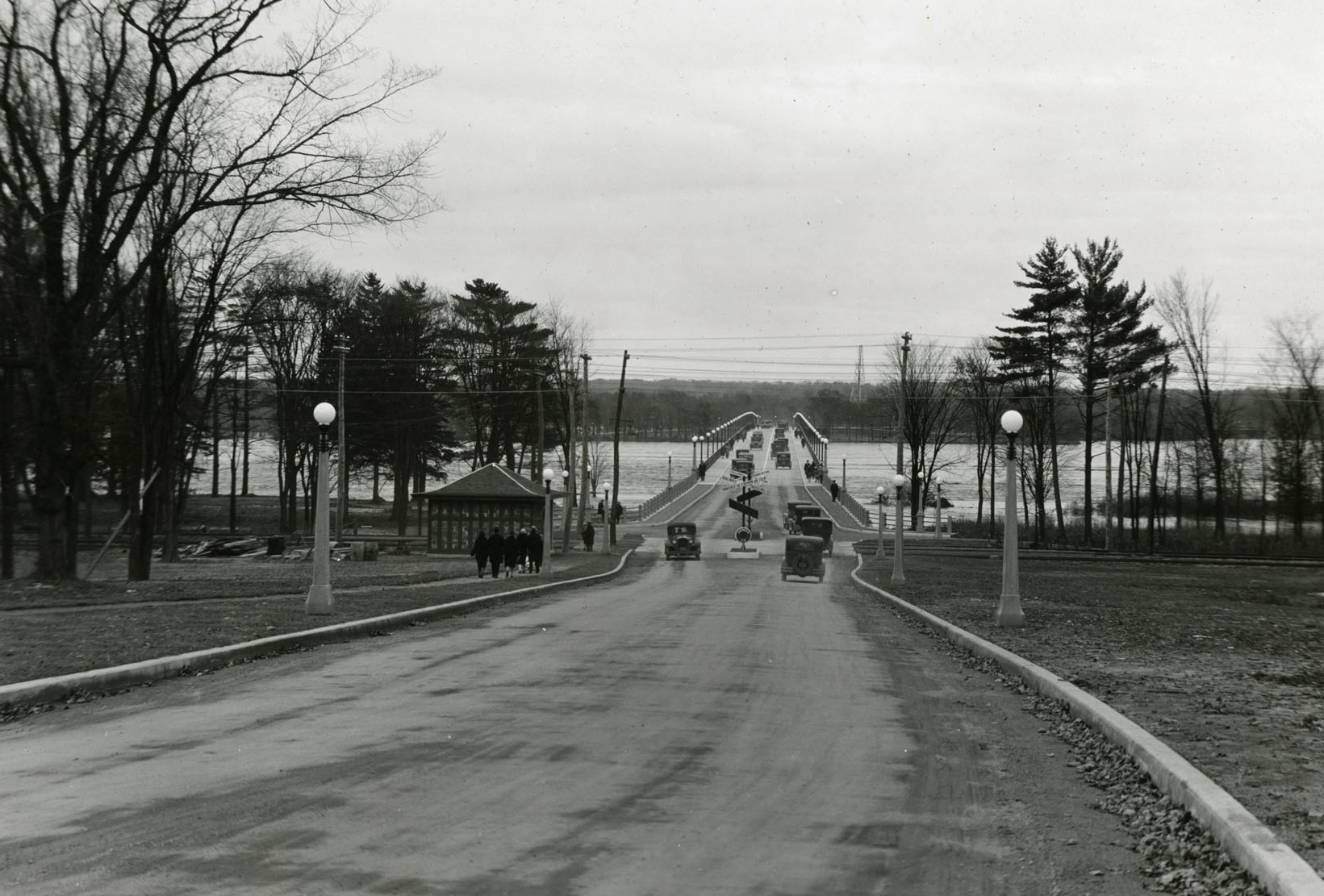
This is a view down Island Park Drive which also shows
its footpath and bridle path. Photographer is standing just 
a little south of where Sunnymede intersects today.
(LAC, PA-034413)

1922 oblique aerial view looking north showing the new West
End Driveway cutting through the wilderness. Other than the
cottages near Westboro Beach and in Champlain Park,
north of Scott at this time is largely just trees and bush.


Late fall 1922: The West End Driveway segment from Richmond Road to the Grand Trunk Railway tracks (where the Queensway runs today) was completed. Efforts to extend south of the GTR in 1922 was delayed due to political reasons (at one point, 100 workers were laid off over an argument between the OIC and city council over the $1,400 cost of a new survey that was required for the area around Ruskin Street). 

Spring-Summer 1923: The Driveway segment from the GTR to Carling Avenue was completed. Meanwhile debate raged about whether a link to Quebec should be made by connecting the bridge from Bate Island or constructing a bridge from Lemieux Island. City Council was pushing Lemieux Island, which made a lot more sense (it was 600 feet from Lemieux to the Quebec side, versus 2,000 from Bate Island), Lemieux Island was seen as a larger and more picturesque potential park space (at 17 acres, versus 11 acres combined for the three small islands), and it was to alleviate congestion at the Chaudiere far more than would a bridge at Bate Island. Ultimately, the OIC was committed to their plan to go to Bate Island, and wasn't worrying in the short term about the Quebec connection. 

September 1924: Work finally began on the Champlain Bridge.

Ottawa Citizen - September 12, 1924

October 14, 1923: The full length of the new West End Drive (aka Island Park Drive) opened for traffic for the first time. There was no ceremony, simply early that Sunday morning, the barricades were removed by the OIC at Carling Avenue, allowing vehicles to travel the entire length from Carling to the River.

Fall 1924: By year end, all of the piers and abutments were in place for the first segment of the bridge to the first island, and it was ready to go for the installation of the iron portion in the spring.

In total there would be 420 feet to the first island (Riopelle). Then 70 feet to the next island (Cunningham), and finally 320 feet to the third (Bate). The bridges were to be built to handle a load of 20 tons, 24 feet wide, with a 5-foot sidewalk on either side. Five piers and six spans in the first bridge, four piers and five spans in the other. Making construction easier was the hard, rocky bottom and shallow water from the shore to the first island.

December 24, 1924: The contract for the iron work of the Champlain Bridge was awarded to Dominion Bridge Company. Their bid was the lowest in the tenders process, and they were to start in the spring of 1925.

Dominion Bridge Company ad, 1919

Spring 1925: The first bridge segments are in place!  And thanks to some photos taken by Pittaway Photos of Ottawa, the moment is captured in time:

(LAC: e999908998-u)

(LAC: e999908999-u)

(LAC: e999909000-u)

Aerial photo showing the bridge in place to the Island.
August 12, 1925

Spring 1926: The flooring for the third bridge (from Cunningham Island to Bate Island) was completed, officially bringing the route to Bate Island to a finish. However, the roadway would not be opened for either pedestrian or vehicular traffic for another year.

May 1927: The Federal District Commission (the new name for the OIC, before it would later become NCC) made an announcement that the islands would be finally soon be opened up, and that all three would be transformed into small natural parks. Cunningham and Riopelle Islands were to be reserved for pedestrians, accessible by a staircase down from the bridge, while Bate would be encircled by a driveway for cars, so that they could park and enjoy the views from all angles. The opening of the bridges was delayed until the islands were ready for the public.

June 20, 1927: Thomas Ahearn, chairman of the FDC, announced that within thirty days, a start would be made on the construction of the "Islands Park" bridge from Bate Island to the Quebec shore, and opened by fall 1928. The start was delayed due to high water, with the concrete work beginning first. 

September 13, 1927: At noon on a warm Tuesday in September, Governor-General Lord Willingdon cut the ribbon for the opening of the bridge to the islands at a ceremony attended by 200 people. The G-G was the first car to cross the bridge. The final price tag on the bridge to Bate Island was approximately $180,000 including the approaches, viaducts and clearing on the island.

Ottawa Journal - September 13, 1927

Lady and Lord Willingdon (Governor-General
from 1926-1931) pictured in 1927, though not at
the opening of the Champlain Bridge

Ottawa Citizen - August 29, 1927


October 7, 1927: The Montreal firm of Quinlan, Robertson and Janin was awarded the $147,000 contract for construction of the sub-structure and flooring for the Bate Island-to-Quebec segment of the Champlain Bridge. The FDC supplied all the stone required (purchased locally) and the cement was supplied by the Canada Cement Company. There was some contentiousness around the selection of the Montreal firm, when most of the eight bidders for the contract were from Ottawa.

October 14, 1927: Construction began right away on the new segment. Careful planning was required, as the construction of a 1,900 foot bridge in rapid-running water was no easy task. All work was done starting on the Quebec side, nothing was brought in from the Ontario or Bate Island side. Before any work could be started, a 25-foot wide trestle bridge had to be built in order to accommodate the equipment needed in construction, including a gasoline-powered locomotive. It was constructed using 10x10 timbers, that would hold the 56 pound rails laid over it. A few photos from LAC capture the earliest days of construction, which ran right through the chilly winter of 1927-28. (I've done my best to try to put them in a chronological order):
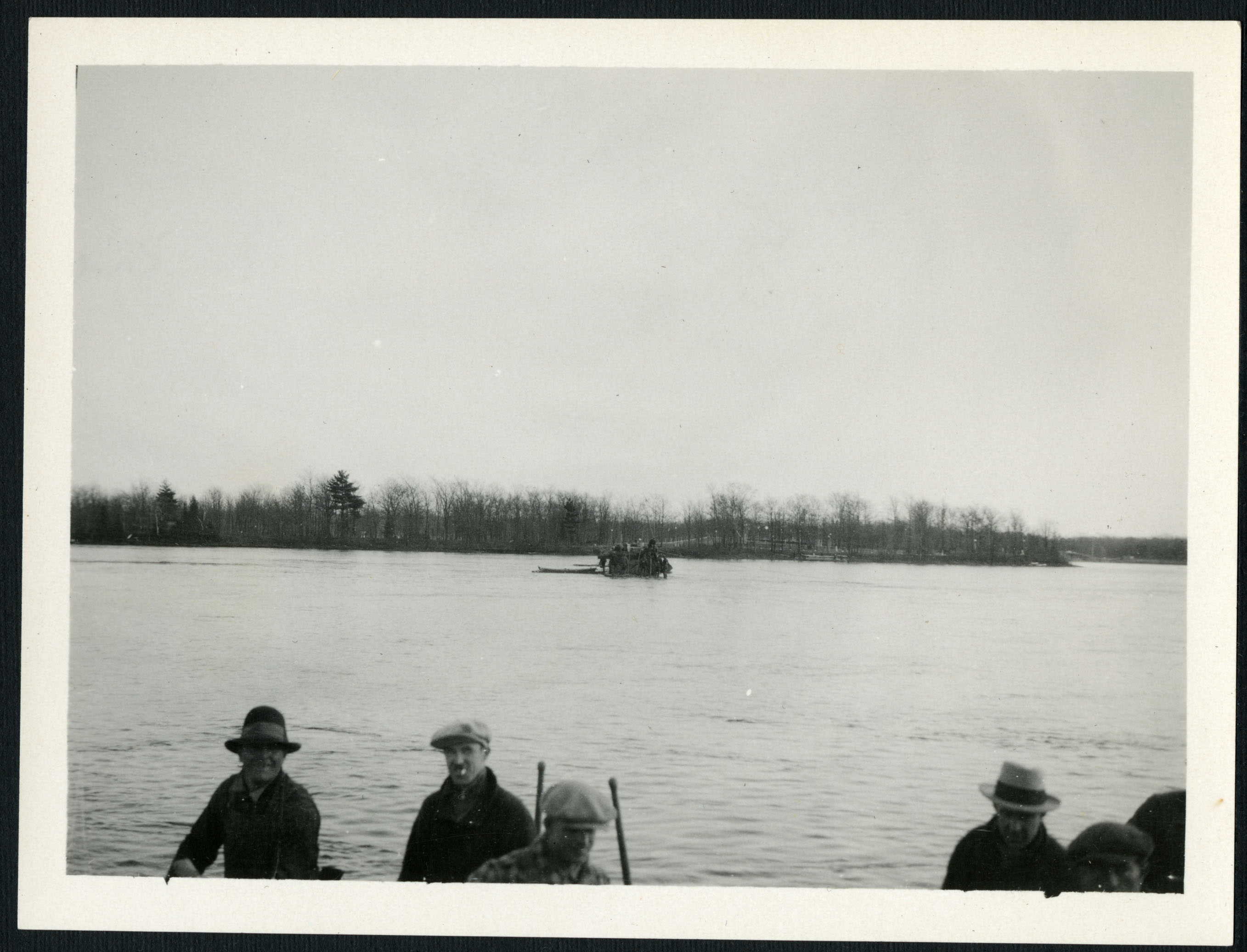
Preliminary work in the water. A floating barge can
be seen in the background, with Bate Island in the
distance. (LAC - e999909060-u)

Group of workers holding their tools in the water,
with the barge still in behind. (LAC - e999909061-u)

Construction site and shanties on the river's edge.
(LAC - e999909062-u)

Trestle bridge under construction. 
(LAC - e999909063-u)

Machinery used in early construction.
(LAC e999909048-u)

Wood shanties and materials for construction
(LAC - e999909059-u)

Logs beind hauled from river during construction.
(LAC - e999909049-u)

Logs being hauled from the River
(LAC - e999909046-u)

Worker in diver suit doing underwater work.
(LAC - e999909050-u)

Underwater work (LAC - e99909056-u)

Trestle work on the shore
(LAC - e999909051-u)

Trestle bridge (LAC - e999909058-u)

Winter 1927-1928: Work continued on the bridge throughout the winter, as the FDC wanted the bridge opened by the fall of 1928.

Icicles form on the beams of the trestle during
the cold winter (LAC - e999909052-u)

Work during winter (LAC - e999909053-u)

Machinery at the Bridge worksite
(LAC - e999909054-u)

Late Spring 1928: the Substructure was in place by May.

(LAC - e999909047-u)

(LAC - e999909055-u)

(LAC - e999909057-u)

(LAC - e999909064-u)

(LAC e-999909065-u)

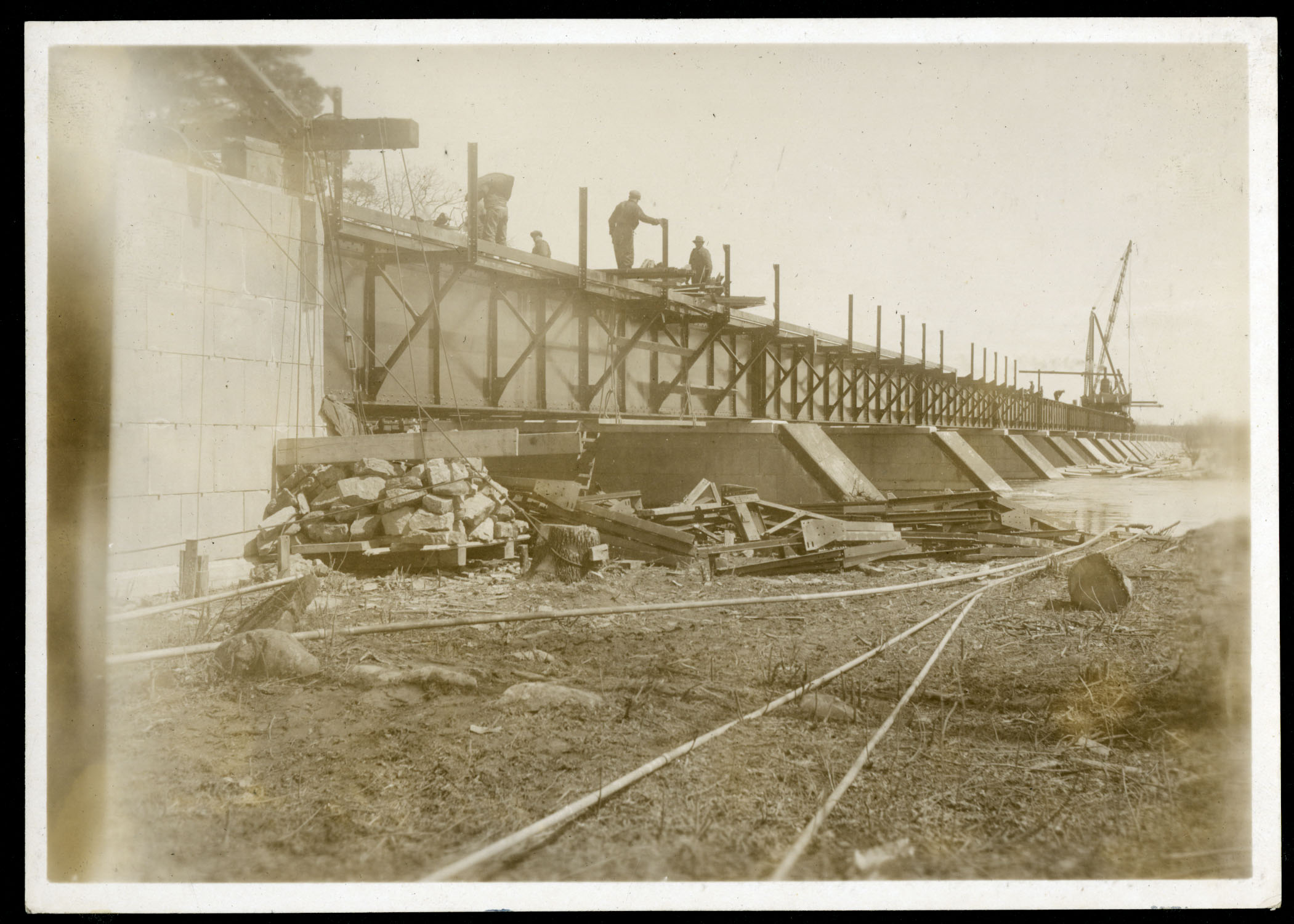
May 23, 1928: The steel work for the Bate Island-to-Quebec segment of the bridge began on this date. It was delayed due to the high water throughout the spring.

Crane moving girders off side-angle
(LAC - e999909002-u)

(LAC - e999909005-u)

(LAC - e999909007-u)

(LAC - e999909008-u)

(LAC - e999909003-u)

Tracks used during construction
(LAC - e999909004-u)

The bridge nearing completion
(LAC - e999909006-u)

(LAC - e999909001-u)

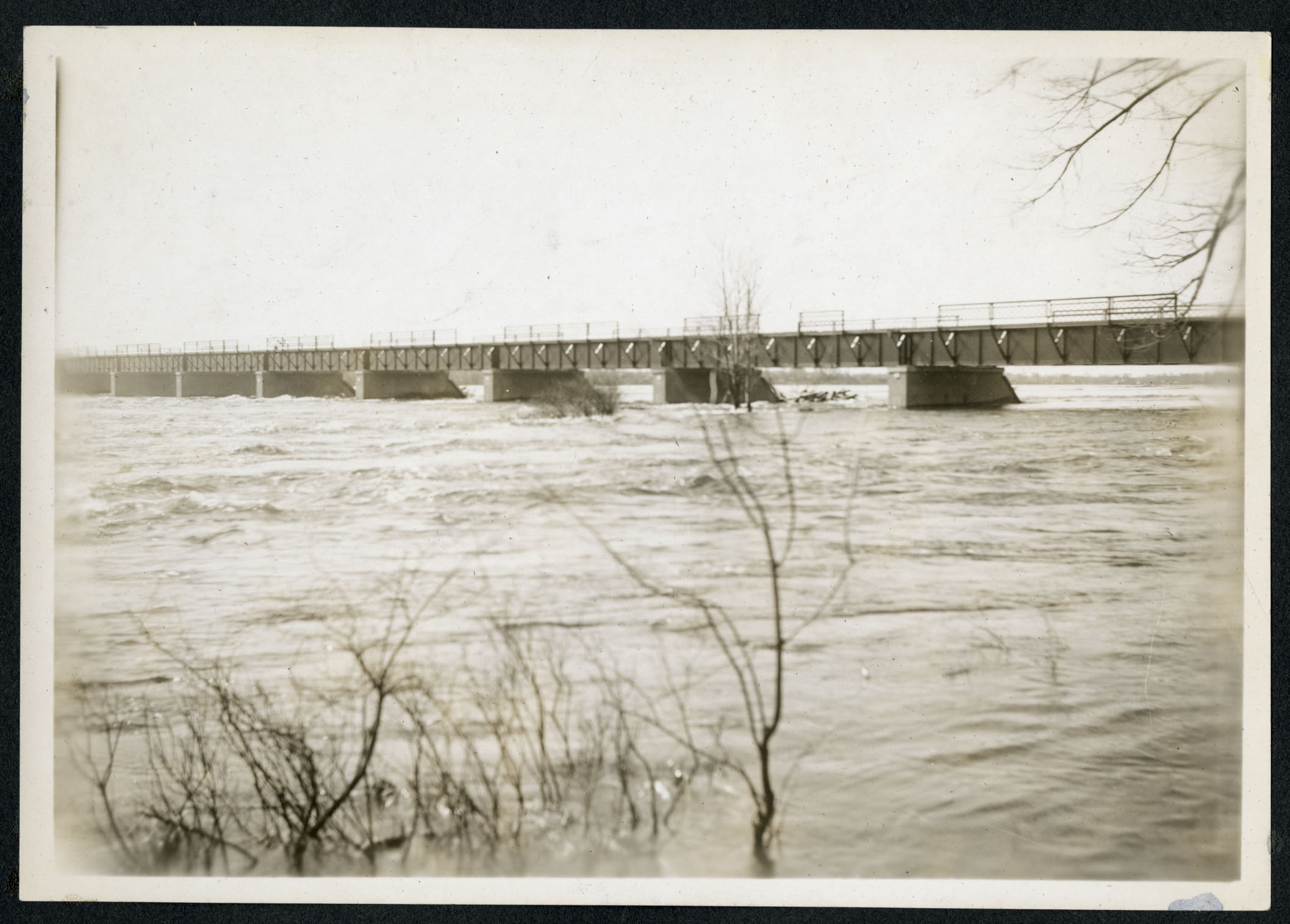
Spring 1928: Just as was warned to the FDC years prior, the area close to the Ottawa River was prone to flooding in the spring, and 1928 was a record-setting year for flooding. While construction work was held up on the north end of the bridge, the south end of the bridge found itself submerged under high water for much of the spring! The RCAF sent a plane overtop to capture the flooding from Woodroffe all the way to Champlain Park, and the photos capture the Champlain Bridge in mid-construction, but also significant submersion:

Spring 1928 view from overtop Westboro Beach

View looking northeast, with the approach to the
Champlain Bridge underwater in 1928.

View looking south towards Island Park Drive
and Champlain Park. The approach and much of 
Island Park Drive are under water. 1928.

Overhead view of Bate Island looking west. The piers
for the new north section are in the water. 1928.

One last view looking southwest, again overtop
of Bate Island. Spring 1928.

Some of the damage done from ground level:

Looking south from the bridge that was washed out
(LAC - e999909024-u)

Island Park Drive under water
(LAC - e999909027-u)

Everything in the area under water. The bridge
and Island Park Drive are in the background.
(LAC - e999909028-u)

May 1928: It was only in May of 1928 that the name Champlain was given to the bridge, and it happened without any fanfare that I can find in any of the local newspapers! It appears the decision was made and the name adopted, but without any coverage. It was selected by the FDC because of the local significance of Champlain stopping in the area of the Remic Rapids to take notes and elevations. FDC Chair Thomas Ahearn later stated in a request to have a plaque added to commemorate Champlain that "the very best monument to the great discoverer is the bridge itself". 

July 6, 1928: The last span on the Bridge was completed.

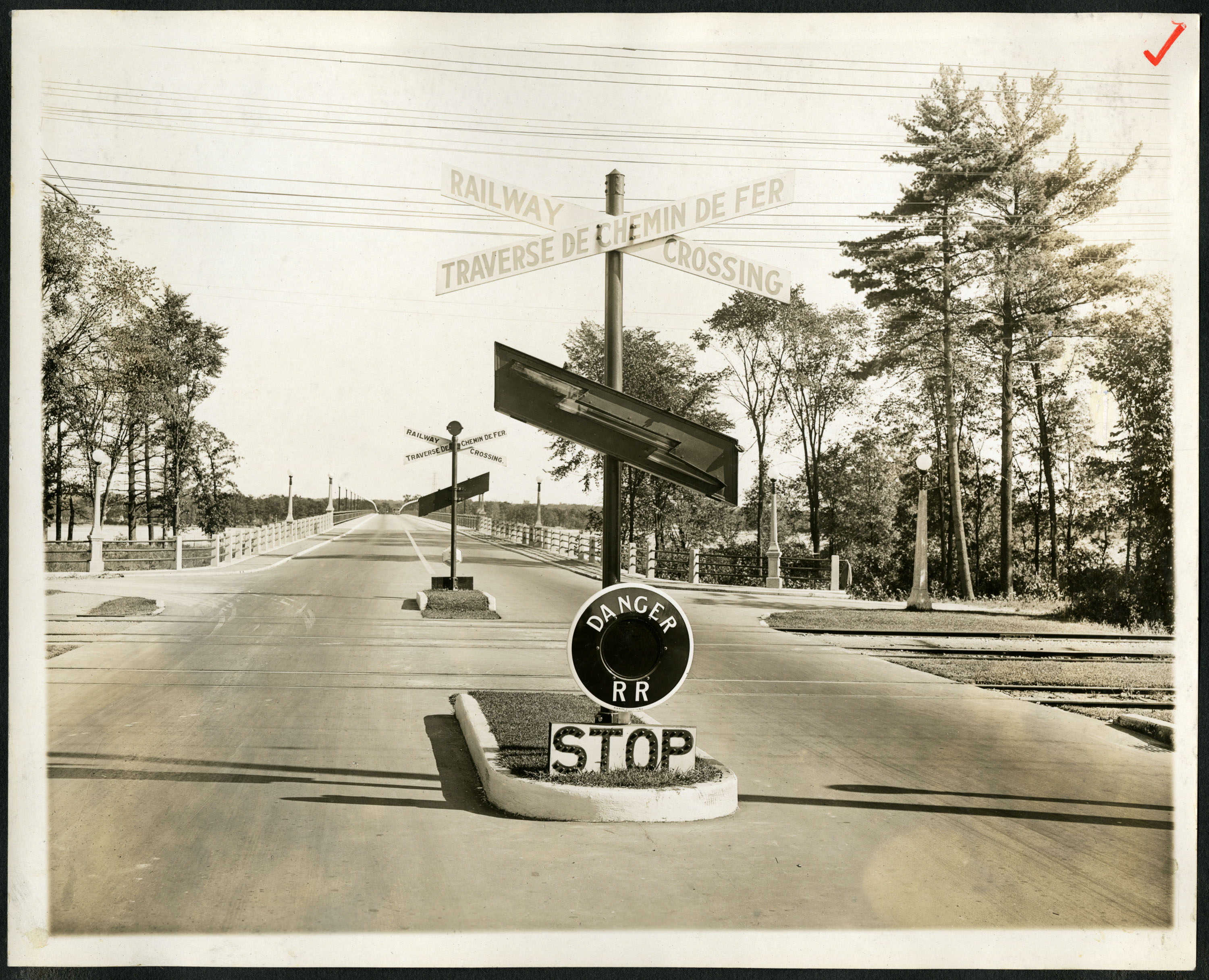
July-August 1928: Because of the annual flooding, and what was considered a dangerous hard turn from the approach to the bridge, the FDC decided to build a new straightaway entrance to the bridge, which is the route that exists today (where Island Park Drive essentially becomes the Bridge in a relatively straight line). The original approach actually was kept by the FDC/NCC and became a parking lot just beside the bridge, though it was covered over a couple of years ago and is now just grassy parkspace.

October 22, 1928: In a grand ceremony held at 3:30 p.m., the Governor-General Lord Willingdon was once again called to cut the ribbon and open the full Bridge to vehicles. He cut the ribbon in the centre of the bridge on the exact boundary line between Ontario and Quebec. At the conclusion of the ceremony, more than 600 cars and hundreds of pedestrians crossed the bridge. Local media reported there were photographers and "motion picture men" on hand to record the event. I wonder where that footage ended up?

Part of front page story
Ottawa Journal - October 23, 1928

On its opening, the engineers were commended for their work in building the entire span from Bate Island to Quebec in less than a year. The opening of the Champlain Bridge was considered a major triumph for the FDC as well, and its chairman Thomas Ahearn. 

Here are some photos from after completion:

The original approach to the bridge from the Ottawa
side, where it came in at almost a 90-degree angle.
(LAC - e999909033-u)

Looking north from the west side of Bate Island
(LAC - e999909035-u)

Looking south towards Bate Island and beyond
(LAC - e999909034-u)

Looking north from the Bate Island turnoff.
(LAC - e999909036-u)

Looking south from the north approach on Quebec
side (LAC - e999909037-u)

Entrance to bridge from Quebec
(LAC - e999909038-u)

Entrance to bridge on Quebec side
(LAC - e999909067-u)

Welcome to Quebec road signs at bridge exit.
(LAC - e999909039-u)

Aerial view from above Quebec side
(LAC - e999909040-u)

Aerial view from above Champlain Park, which
shows both the old and new approach
(LAC - e999909042-u)

Aerial view above the islands looking north to
Quebec side. (LAC - e999909043-u)

I hope you enjoyed this photographic journey through the construction of the Champlain Bridge! 

Saturday, December 10, 2022

Goodbye Ottawa Neighbourhood Services

 For the Kitchissippi Times' December issue, I wanted to write something in the vibe of the Christmas season - a time of year of charity and giving. And there is no organization more tied in to charity and giving in the history of Kitchissippi than Ottawa Neighbourhood Services. 

Sadly, many people reading this won't even recognize that name. Many others will remember it of course but will have thought the organization closed years ago. In fact, it was just during Covid that the last traces of ONS disappeared. It's a tragic and unfortunate ending to an organization that was so integral to Ottawa, and especially to the Hintonburg neigbourhood. 

And perhaps even more troubling is the fading memory of it's founder and long-time operator Harold Mayfield, who basically dedicated his life to the organization. 

You can read the full article here:

https://kitchissippi.com/2022/12/11/early-days-the-forgotten-legacy-of-hintonburgs-first-thrift-store/

Somehow, the concluding paragraph of the column I submitted got cut off in the final edition, perhaps due to length. But I wanted to re-add it here, as it expresses the disappointment I have at the loss of Mayfield's name in the community:

"It’s a veritable tragedy that the ONS is gone, and just as sadly the Mayfield name is nowhere to be found, including no longer even on his building. A man and an organization that did so much through the many decades of Kitchissippi’s history when the area was working class, and not yet gentrified, the imprint Ottawa Neighbourhood Services had on our community cannot be measured."

It's true... I still remember seeing the "Mayfield Building" name emblazoned on the building at Wellington and Garland as a kid. This would have been in the 90s, so not that long ago. I can't remember if it was on the side or front of the building, or how it was (I feel like it was overtop an entranceway), but regardless, the name is now gone and can't be seen anywhere. If you Google "Mayfield Building" in Ottawa, pretty much it is just my article that comes up. That's really too bad that we don't have anything permanent to honour the contributions of Harold and Marjorie Mayfield. 

The ONS building in 1985

Thursday, November 10, 2022

Tracking down the Hintonburg Howitzer

With Remembrance Day falling in November of course, I wanted to do something on that theme for my Kitchissippi Times column. A few years ago, Paulette Dozois had written a short article for Newswest about the discovery of an old photo from the 1920s of a howitzer gun placed in Somerset Square. It was a piece of long-lost Hintonburg history that no one knew anything about. What was it for? How did it get there? Where did it go? 

I took a shot to figure out all these answers, and was amazed that I was actually able to track down the history! Thanks to one of the Ottawa newspapers of the day actually publishing the serial number of the gun as it discussed it, and an amazing website The Searchers (https://warsearcher.com/the-silent-batteries-war-trophies-of-canada/war-trophies-allocation-and-details-database/comment-page-1/?unapproved=3996&moderation-hash=a35253179054307dfcd8140809061986#comment-3996) that attempts to track the history of all of Canada's war trophies, I was able to come up with the full story of the Hintonburg Howitzer.

What is not 100% definite (though is 99.999% sure) is where it ended life. And it appears it was melted down as part of the war effort for WWII. Just after print deadline, Alex Comber, who maintains The Searchers website, had come up with an old scan he had made from the LAC holding on Malak Karsh, Yousuf’s brother, was an Ottawa-based photographer too, and went around photographing the old war trophies that were neglected and likely to be melted down. His feature was called "Canada Melts its War Trophies", and wihin it, is a photo that apparently shows the old Hintonburg Howitzer sitting snow-covered in back of the dump by Bayview and Scott. 

Malak Karsh: Canada Melts its War Trophies
(LAC R11612 1985-070)

Anyhow, it's an interesting story, and really it's too bad the gun wasn't better maintained and isn't still holding a place at Somerset Square. 

Have a read of the full story at: https://kitchissippi.com/2022/11/24/early-days-wartime-history-tracking-down-the-hintonburg-howitzer/

Monday, October 10, 2022

150 Years of Mechanicsville

A major milestone quietly occurred in 2022, the 150th anniversary of Mechanicsville! It was back in 1872 that the neighbourhood subdivision was first laid out, and the first houses built. Over the past few years I have been researching Mechanicsville's history extensively, and so I was easily able to write a (very quick) summary of how Mechanicsville developed for the October Kitchissippi Times. It's a really neat story for which this column only scratches the surface. I have been aspiring to write a book, and my original goal was this year (2022) to coincide with the anniversary. But the pandemic scuttled those plans as I was not able to complete the interviews I needed. I still hope to have a book finished at some point, because I think it's absolutely necessary to have the stories of Mechanicsville recorded as the neighbourhood changes so fast, and little of the old houses and people remain. 

Mechanicsville itself was not in a position to be able to celebrate the 150th as Laroche Park was in full redevelopment mode and not usable. So I think the community may have plans to low-level celebrate the anniversary in 2023.

Either way, I look forward to getting a book finally done, and if you, or someone you know would be a good candidate to meet with me to share old stories and photos, I would love to hear from you!

For now, enjoy this article!

https://kitchissippi.com/2022/10/05/150-years-of-mechanicsville-the-neighbourhood-forged-through-hard-work/

Saturday, September 10, 2022

The doctor is in: Meet Israel Goldwin Smith, Kitchissippi’s first doctor

My Early Days column in September's Kitchissippi Times was a long-overdue profile on Dr. Israel Goldwin Smith, who was the first Doctor to open a practice within Kitchissippi's borders. He was a mainstay in Hintonburg from 1896 until his passing in 1936. As you can imagine, life as the doctor in a growing turn-of-the-century village had its interesting highlights. I was pleased to have the opportunity to meet Dr. Smith's granddaughter, who shared some great stories and photographs. 

You can read the full article at the Times here:

https://kitchissippi.com/2022/09/09/the-doctor-is-in-meet-israel-goldwin-smith-kitchissippis-first-doctor/


Wednesday, September 7, 2022

A hidden piece of 124-year old Wellington Village history


The oldest building on Wellington West in Wellington Village may come as a surprise. It's a smaller, square old building that is somewhat squeezed between two much more well-known buildings. But it has a unique and interesting history all its own, and for years I've wanted to unearth that history, which I've done over the last couple of weeks finally!

The timing is good, as there is a new business opening up in half of the building this week. The Thrifted Mini is a popular kid's consignment business which has existed only online, until now. They open in their first physical commercial space in today (September 8th) here in Wellington Village, in this historic old building. 

That's the present, but the building at 1239, 1241 and 1243 Wellington Street West actually has a history that ties back to the late 1800s!

It's hard to tell from the street, as the commercial portion of the building that abuts the sidewalk is most of what is visible, but behind the 13-foot 1950s addition is an old square duplex house that was built 124 years ago and has seen its share of west end history over its impressive lifetime!

Construction & ownership history

The construction of the building appears to have been a messy affair. Land registry transactions were not registered as immediately as they are today. Back then, sales, mortgages and other transactions could take months or years to be officially registered. Often a seller would cut a deal with a buyer on a handshake or verbal deal, and only after certain conditions were met would the transfer go through. Thus, specific dates are lost in piecing together the construction of the building, and even pinpointing 100% who the builder(s) were. Making things even more challenging is that none of the bills for the construction were paid to the contractors, and the owner skipped town altogether, leaving the building in legal and financial limbo for several years.

Information indicates it definitely was constructed in 1898. It is possible that there were two people who owned the property and oversaw construction. Guillaume Chouinard (his wife Albina on the paperwork, as was common in the era), certainly acquired the lot from the well-known Hintonburg Stott family for $450, and took out the initial mortgage towards construction of the building, for $1,200 from the Canadian Mutual Loan and Investment Company. Whether Chouinard started the project and sold it off mid-way through is lost to history, but at some point, either early or during the project, he got out of the whole thing, and sold it to a young man, 22-year old Oscar Alexander Philion, a former journalist with the Ottawa French language newspaper 'Le Canada'.

The building appears to have been completed by late 1898, but the end of the project was disastrous. In my research, I'll occasionally come across a "mechanic's lien" on a property, which is registered when a contractor has not been paid for work done on a property. It's a legal lien placed against the property until the owner's debt is paid. It is sometimes common to see even two liens placed on the same project. But seven??? I've never seen anything close!

Something happened, the exact details of which appear to be lost to history, but whatever the case, starting in early September 1898, the liens started rolling in. Meanwhile Philion had skipped town, and his father Alphonse Philion was dragged into the financial affair. By Christmas, the Citizen was reporting the details of his experience with the 2022nd regiment of New York, Philion apparently enlisted in July 1898 when the Spanish-American War broke out!

Ottawa Citizen
December 21, 1898

Philion stated he may return to Ottawa in the spring, but that never happened. The 1900 US Census caught him as part of a regiment in Dumanjug in the Philippine Islands, and some light digging on Ancestry revealed he ended up a couple of years later in St. Joseph, Indiana, where he married, began his family and lived the rest of his life, never returning to Ottawa.

The builder of 1239-1241 Wellington 
Oscar Philion (pictured at his 1903 wedding)
Source: Ancestry.

Back to the building on Wellington Street... The good news about all of these liens is that it gives us a full list of who was involved in the construction of the building in 1898, which is quite rare. 

That list of liens, and their values includes: George Faulkner ($30.90), Louis Piché ($42.00), Samuel McArthur ($83.50), William F. Frazer of Frazer & Hamilton ($188.14), the Farley Bros. ($168.30), Edward Clairmont ($50.00), Henry Living ($56.47). 

Samuel McArthur is the most notable of the names on the list. He was a well-known local small-time house builder, and very likely was hired as the lead for the construction. He was living on Carruthers at the time. 

The Farley Bros. were a Hull-based brickworks and lumber plant, where a lot of the building materials were likely sourced; Frazer & Hamilton was a small sash and door factory and planing mill at 46 Elm Street; and Henry Living operated a hardware store at 105 Bank Street, where some of the tools and materials were likely sourced.

Louis Piche (a butcher from 10 Eccles), George Faulkner (a teamster living in Mechanicsville), and Edward Clairmont (a carpenter on St. Patrick Street) were likely labourers on the project.

All of the liens were registered between September 3 1898 and February 22 1899, and in March 1899, certificates of lis pendens were issued, with some of the contractors suing each other, and the whole thing is just a financial mess. In the end, it appears that the original mortgage holders, the Canadian Mutual Loan and Investment Company, took over ownership when the mortgage owing by Philion was obviously defaulted on, and would have paid off all the liens. And oddly, they (Canadian Mutual) maintained ownership for the next decade, acting as landlords to the property. (At some point it had become the Colonial Investment and Loan Company, but was conveyed to the Anglo American Fire Insurance Company by about 1910).

The house was originally numbered 227 and 229 Richmond Road (as Richmond road extended to Western Avenue until 1908, when that portion was renamed to Wellington Street). 227 was the east half (1239 Wellington) and 229 the west half (1243 Wellington).

Anyways finally in March 1910, it was sold to William Joynt, a Hintonburg-based real estate investor and agent, for $2,000. It was very common in this era, for real estate dealers to actually purchase the building and re-sell it, unlike today where the agent simply coordinates the sale. 

Within days of purchasing the building, Joynt had it listed for sale in the Journal with a large ad:

Ottawa Journal - March 19, 1910

Even Joynt at the time saw the potential the building had in being converted for commercial purposes. 

Of course it is obvious even more so today that this should have been its original build type, but at the time of construction, Wellington Village was still just largely vacant farmland. Most of the land was owned by the Ottawa Land Association, who were still nearly 20 years away from offering it for sale. 

If you were standing at the corner of Holland and Wellington at the time, you would have seen only a handful of structures to the west, before the small subdivision around Carleton Avenue. Wellington Street was a commercial thoroughfare only up to about Holland Avenue at the time, when it transitioned to being the road out to the country, towards Bells Corners and Richmond. Even the streetcar line (which arrived in 1900, two years after the building was completed) turned off Wellington at Holland, turning south towards the Farm. So though one could have foreseen a likelihood that Wellington would eventually grow into a commercial street further to the west certainly in 1910, and even possibly in 1898 when the building was first built, it wasn't a sure thing, and certainly would have had minimal interest for commercial purposes at the time.

Joynt incidentally had also acquired the property next door (to the east, at the corner of Holland) in August 1906, which at the time had a small wood-frame duplex.

He kept ownership of both properties, which remained in the Joynt family as tenanted properties until the mid-1940s. Joynt passed away in 1930 after an incredible career, working his way up from a grocery store owner in Hintonburg to becoming the largest landlord in the west end, to eventually being appointed Magistrate for Carleton County (despite having no legal training!).

View of the two buildings on the 1922 fire plan.
That is Holland on the right edge. The pink colour
indicates brick, yellow is wood, and grey represents
a small garage, shed or outbuilding.

Aerial photo from May 5, 1933. Also visible is the
"Holland Service Station" which opened at the corner of
Huron in 1926, and remained there until about 1973.

The building was sold in June 1946 to William E. Haughton for $7,250. Haughton also acquired the lots to the west, and constructed the Haughton Building (better known as the Bank of Montreal building) in 1947 to house his law firm. Haughton built his new building abutting the duplex at 1239-1241 Wellington, which actually ate 7 feet into the original lot space of 1239-1243 Wellington.  

Haughton continued to rent the duplex out to tenants over the next few years. He later, in October 1951, acquired the property to the east, which was still the old wood-frame duplex, for $23,000 (the Joynts had sold it in 1945, but Haughton re-acquired it). At the close of 1951, Haughton owned the entire block of Wellington from Huron to Holland.

In April 1953, Haughton sold the two lots (not his building, but the two duplex buildings) to Pearl E. Fenton for $52,000. Pearl Fenton was the wife of George Wesley Fenton.  And he had big plans for the property.

In 1953, he renovated the building at 1239-1241 Wellington, putting on a small addition at the front of the building to bring it to the sidewalk line, creating a commercial frontage to the building. 

On the east half, at 1239, he opened the 10th bakery of the local Fenton's Bakery chain that would eventually grow to 12 branches. 

Ottawa Journal - September 30, 1953

The renovation essentially eliminated the main floor residential portions of the house. There were commercial spaces on both halves of the main floor (1239 on the east half, and a new number 1243 Wellington Street West on the west half). Upstairs was both 1241 Wellington West, with a small commercial space on the east half, and a residential unit on the west half. Interestingly, the long-time tenants on the west half remained in the building, even after the renovation eliminated the downstairs half of their home! 

I wish I had a photo of the building prior to the renovation, but I have yet to find one! If anyone reads this, and has an old family album with a photo of even a part of the original building visible, please let me know.

Meanwhile, in late 1954, Fenton demolished the old wood-frame duplex at the corner, and immediately took out a permit to construct the Wesley Building. It was completed just in time for Christmas 1955, by James More and Sons Ltd., at a cost of $225,000.

Below are two photos (and one neat illustration) of the construction of the Wesley Building, the middle photo shows a good view of the newly-renovated Fenton building, with Richards Jewellers on the left, and Fenton's on the right. The old Haughton Building sign which was once fully exposed is now seen as mostly covered up by the front addition.

Ottawa Citizen - June 8, 1955

View of 1239-1241 during the construction of the
Wesley Building, September 21, 1955
(City of Ottawa Archives, CA-25262)

The Wesley Building completed. December 1955
(City of Ottawa Archives CA-35918)

Another good way to see the renovation and new construction visually is the comparison of the 1948 and 1956 fire insurance plan sheets of the block. See below:

1948 fire insurance plan, pre-reno

1956 fire insurance plan, showing the new front
addition (the blue colour indicates concrete block
construction), and the new Wesley Building

The building at 1239-1241-1243 Wellington has largely been unchanged since 1953. The biggest change has probably been the addition of a large parking garage in behind the building, which appears to have been constructed during the 1990s. In older photos from the 60s and 70s, it appears there were actually a couple of larger trees in this space.

Rear of 1239-1243 Wellington West - September 2022

In fact, a 1939 article mentions that long-time tenant Mrs. Beckworth hosted a large garden party and bingo in the house and grounds of the house! So it must have had a pretty nice backyard for a time.

Ottawa Journal - August 7, 1939

Fenton Realty owned 1239-1243 Wellington until March 1st, 1984, when they sold it for $950,000 to an numbered Ontario incorporation, and it later sold again in 1986 for over $2M. I didn't bother tracking its more recent sales.   

The early occupants: 1897 to 1953

The earliest confirmed inhabitants of the house are from the 1901 Census, where the east half (227 Richmond/1239 Wellington) was occupied by William A. and Charlotte Mason and their two children Robert and Catherine, ages 4 and 2. William was Village Clerk for Hintonburg at the time, which meant he was photographed as part of Hintonburg's Council in 1897:

William A. Mason in 1897

The west half of the duplex (229 Richmond/1243 Wellington) had interesting residents as well, James and Mary Mark, an Irish couple in their 80s, along with their 39-year old daughter Martha, and an 11-year old grandson Bertram Smith. (James would go on to live to the amazing age of 95). 

1901 Census-taker made his visit to the home on April 2nd, 1901, and also noted the house was brick, with 6 rooms in each half.

Tenants of the era often moved frequently, it was very common to see a new occupant in a house each year, and it was rare to see someone staying more than a couple of years.

By the summer of 1902, both sides had new occupants: 227 was occupied by Harry L. Routh, an electrician, while 229 was occupied by James Carkner, a clerk. 

227/1239 was occupied next by Thomas Turvey, a conductor for the Ottawa Electric Railway (1903-1904), before carpenter Thomas C. Fagan and his wife Elizabeth moved in for the long haul (1906-1930), then Emile and Emily St Aubin (1931-1933), Alfred and Marguerite Leduc (1934-1950), Hubert J. and Agnes Shellard (1951) and Clifford H. and Claudette Tyo (1953).

229/1243 meanwhile was occupied by James Carkner (1902-1909), James E. Sullivan (1910-1914), Leslie Tennant (1914-1916), Sophia Beard (1917-1920), Sidney E. Day (1921), Charles G. and Helen McFadden (1922-1934), Cecil W and Inez Joynt (1935-1937), and then the longest occupants, Bernard H. (Tom) and Agnes Beckworth (1938-1961). What's most interesting about the Beckworths is that they remained in the house even through the conversion to commercial, and would have had to accept the renovation which would have halved the size of the apartment in 1953.

The WWI period is worth discussing, as both sides of the building saw the occupant families significantly affected by the war.

Thomas Fagan in 1239 was employed as a saw filer, and must have been a pretty tough character, for he enlisted in March of 1916 to fight for Canada. What made him a bit unique was his age: Thomas was 46 years old at the time. He also had four children, ranging in age from 15 years to his daughter Frances who was only 13 months old. Within a month, he was in England, a member of the 224th Canadian Forestry Battalion, with the rank of Private. He was soon shipped to France, where he spent the next two and a half years, until the end of the war. He returned home in May 1919, a Lance Corporal, and just shy of 50 years old. For those three-plus years he was away, it must have been difficult on his wife Elizabeth. 


On the other side of the building was the Beard family. Mrs. Sophie Beard, lived alone, though apparently estranged from her husband Henry. The family had moved to Canada just five years prior (1912) from England, seemingly following over a daughter who had married and come to Canada in 1910. Sophie lived with her five youngest children (Henry, Lawrence, Edward, Lucy and Annie) who ranged in ages from 14 to 25. A short Citizen interview with her in May 1918 noted that the family of Mrs. Beard "has done its duty", as she had her two sons (Lawrence and E.C.), her son-in-law (Nelson Baker) and "forty near relations" fighting in the war. Sadly, I later found a Citizen article from November 1st of 1918, noting that the family had received word that her Pte. Edward Charles Beard had died on October 25th 1918, at the age of 20, from gunshot wounds in the head and arms in battle on September 30th.


The occupants: 1953 to Present

These were the commercial years, when the building was converted by the Fentons. Of course the upstairs remained largely residential into the 1990s or even 2000s. It has only been in the past few years that commercial tenants have been located here. It's the ground floor level where all the action has been!

On the 1239 (east) half, Fenton's Bakery remained for 17 years, and is likely the most memorable tenant of the building for long-time residents. Frustratingly, I could not find a better photo of the storefront from the 50s or 60s, than the photo above showing it next to the Wesley Building under construction. Here is a sample storefront view of a different Fenton's location:

Fenton's Bakery (not the Wellington location!)
storefront view (City of Ottawa Archives CA-44523)

Fenton's also had a popular location in the neighbourhood at Westgate for many years. 

Fenton's closed at 1239 Wellington in 1970, and closed their final store between 1974-1975, the end of a very popular Ottawa franchise.

In 1970, Fontaine's Colour TV and Stereo shop (1970-1975) opened up in Fenton's place.

Ottawa Journal
February 12, 1974

Then, Overseas Varieties (aka Overseas Imports) opened at 1239, operated by Amir Mussani, an Ismaili Muslim who was forced from Uganda when President Idi Amin expelled 52,000 non-citizen Asians for "sabotaging the economy". Canada opened its doors to 5,600 of these refugees, bringing them in through chartered planes, with 200 settling in Ottawa. Mussani's shop dealt in "imported garments, brass and wood carvings", and was open into the early 1980s.

Mussani in his shop
Ottawa Citizen, September 15, 1977

From what I can tell, around early 1987, Jimmy's Hair Stylist (which had been open for about two years prior in the 1243 half) expanded and took over the entire commercial space of both 1239 and 1243. It appears (though I could be wrong), that for the next 12 years or so, the ground floor was combined as one business space, later being re-split as it previously had been, around 2002.

Jimmy's remained open until about 1990, when an H&R Block moved in briefly.

Ottawa Citizen - December 8, 1987

Records are a bit spotty from the mid-90s onwards, but some of the more recent tenants of 1239 Wellington have been the Wellington Gallery & Gifts (1992); the Avalon Bookstore (specializing in spiritual healing) from 1995-1999; Tuesdays the Romance Store from about 2007-2015; and The Cell Doctor from about 2015-2017. Google Streetview reveals that the shop remained vacant and for lease until late 2019, when Panash Dry Cleaning opening, but they had the misfortune of opening just as Covid hit, and I guess never stood a chance, gone not long after opening. As mentioned at the start of this article, The Thrifted Mini becomes the newest tenant of this great location this week!

**

The 1243 (west half), has had some varied tenants over the last 70 years as well.

Brookshire Cleaners Ltd. were the first, opening a branch location in late 1953 or early 1954, but only staying about a year. 

Ottawa Citizen - November 16, 1953

Richard's Jewellers, shown in the 1955 photo above stayed for a few years, from 1955-1959.

Ottawa Citizen, December 3, 1953

They were followed by Capital Watch Repair (1960-1961), and then became a beauty salon for the next nearly thirty years. 

At first it was Muriel's Beauty Salon (1963-1973) operated by Muriel MacGregor, then Alex's Hair Design (1973-1986), and finally taken over by Jimmy's Hair Stylists as a second location (their initial location was at 905 Carling). 

Ottawa Citizen - November 13, 1967

Around 2002-2003 I believe, the commercial space was re-split into two separate shops, and the 1243 half briefly was the sales office for the Routeburn Urban Developments condo at 1277 Wellington West prior to its construction, and then became Heavens to Betsy from 2003 until they moved to Hintonburg in 2008. Allegro was in for several years (2011 or 2012 until 2016), then finally the Kindred Shop & Studio which has been in 1243 Wellington since 2017.

Here are a few final random photos of the building, to close off this exhaustive history of one of Wellington West's most unexpectedly-historic buildings!

June 5 1984 aerial view

April 2009 view

2020? doorway to Perfect Electrolysis upstairs

April 2021 view